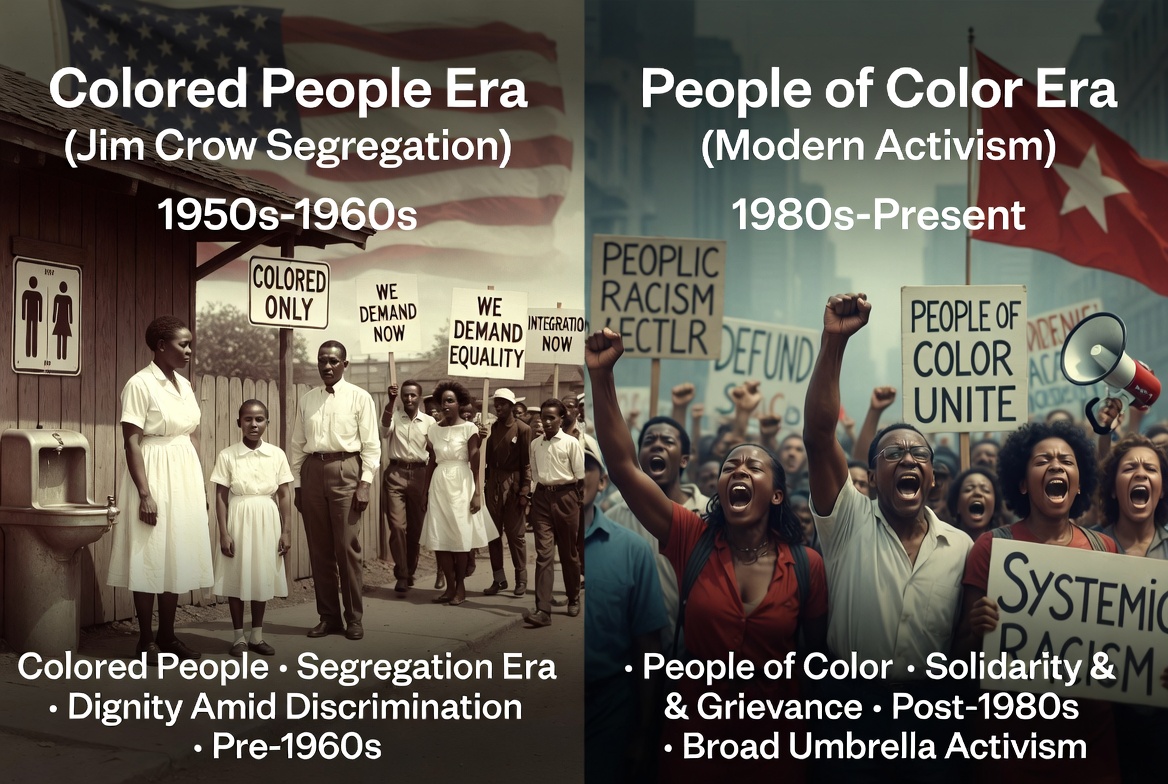
Phrase: Colored People vs. People of Color – Why Ron?
Ron, do you know that the two phrases are semantically very similar — both refer to non-white people — but they differ significantly in historical connotations, word order, social acceptability today, and how they’ve been used over time.
Grammatical/Structural Difference
- “Colored people”: Adjective (“colored”) + noun (“people”). This structure treats “colored” as a direct descriptor or label for the group.
- “People of color” (or “person of color”/POC): Noun (“people”) + prepositional phrase (“of color”). This frames it as people who possess or are characterized by color, often seen as more neutral or person-first.
Linguistically, they’re near-synonyms, but English often treats word order and phrasing as carrying different emotional weight (compare “Black people” vs. older terms).
Historical Usage
Both terms have old roots and were once used somewhat interchangeably:
- “People of color” dates back to at least the late 1700s/early 1800s (e.g., French gens de couleur for free people of mixed African-European ancestry in the Americas, or in early U.S. laws). It could refer broadly to non-whites or mixed-race individuals.
- “Colored” (as in “colored people”) was widely used in the 19th century, including by Black Americans themselves after emancipation as a term of dignity. It appeared in the name of the NAACP (National Association for the Advancement of Colored People, founded 1909) and referred mainly to Black Americans (sometimes broader non-whites).
During the Jim Crow segregation era (roughly 1870s–1960s), “Colored” became the official label on signs for separate facilities (drinking fountains, restrooms, schools, etc.), tying it directly to legal discrimination and second-class status.
Why the Modern Difference in Acceptability?
- “Colored people” is now widely viewed as outdated, offensive, or a slur in contemporary American English. It evokes the segregation era, subservience, and overt racism. Even accidental slips (e.g., a TV anchor saying it) can trigger strong backlash because of those associations.
- “People of color” gained renewed popularity from the 1980s onward as a broad, inclusive umbrella term for non-white people (Black, Latino, Asian, Native American, etc.). It’s promoted in activism, academia, and media as a positive or neutral collective descriptor that emphasizes shared experiences with racism while avoiding “minority” (which implies numerical inferiority).
The reversal happened as language evolved: older terms like “Colored” and “Negro” were largely replaced by “Black” in the Civil Rights era, then “African American,” with “people of color” emerging as a broader solidarity term.
Context Matters
- In South Africa, “Coloured” (capitalized) has a specific meaning for people of mixed ancestry and is still used.
- Some critique “people of color” as lumping diverse groups together or centering whiteness implicitly (whites as the default “colorless”). Others note it’s not universally embraced by all non-white individuals.
- Specific terms (e.g., Black, Asian American, Indigenous) are often preferred over broad umbrellas when possible.
In short, the difference is mostly historical baggage and cultural evolution, not strict grammar. Language norms shift based on lived associations more than literal meaning. Using “people of color” aligns with current mainstream usage in the U.S.; “colored people” does not.
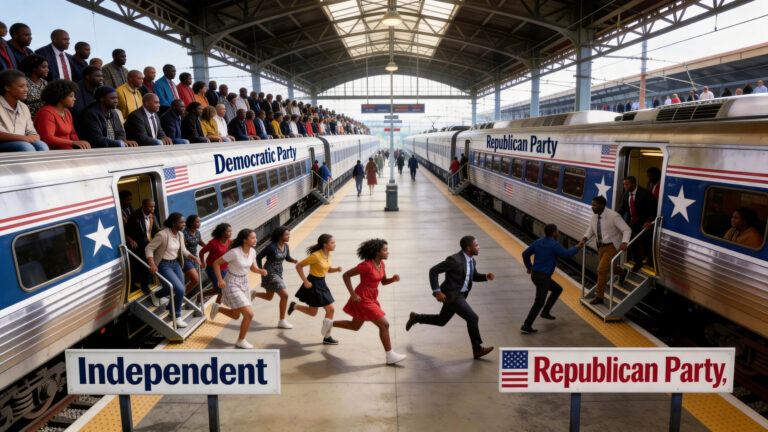
The divide you’re asking about isn’t universal—most Black Americans across political lines express pride in the U.S. (majorities say they are proud to be American), but there are clear, measurable differences in emphasis, intensity, and framing that correlate strongly with political affiliation. Blacks remain overwhelmingly Democratic (~83% Democrat or lean Democratic per Pew 2024, though Trump gained to roughly 12-15%+ of the Black vote in 2024, especially among men). Nationally, patriotism (measured by Gallup as “extremely/very proud”) shows a massive partisan gap: Republicans hover at 90%+, while Democrats are around 36%. Blacks as a group have reported lower average pride than Whites for decades, but the intra-Black split tracks ideology/party: conservative-leaning Blacks (a minority, often ~1/3 self-identify as conservative on social/moral issues) tend to highlight America’s opportunities and progress; liberal/Dem-leaning Blacks more often emphasize persistent flaws and the need for systemic change.
This isn’t about one side “loving” and the other “hating” America in absolute terms—it’s about differing diagnoses of America’s strengths vs. shortcomings, rooted in real data on education, family/welfare, economics, culture, and history. I’ll lay out the applicable causes on each side factually (drawing from polling, historical reports like the 1965 Moynihan Report, Census trends, and academic analyses), without endorsing any party. Both perspectives contain partial truths; outcomes like Black poverty (still ~18-20%), single motherhood (~70% of Black births non-marital today vs. ~25% in 1965), and crime disparities are real and debated as causes vs. effects.
Causes Emphasized by the Critical/Systemic Side (Predominantly Democratic-Leaning Black Americans)
This view frames America as having made progress but still structurally tilted against Blacks due to historical and ongoing barriers. Data shows ~52% of Black adults see racism in U.S. laws/systems as the bigger problem (vs. 43% individual prejudice; Pew).
Education and “Ignorance” Framing: Public schools and universities often teach U.S. history with heavy emphasis on slavery, Jim Crow, redlining, mass incarceration, and “systemic racism” as enduring features (e.g., via curricula influenced by critical race theory or 1619 Project-style narratives). Critics on this side argue this is truth-telling that counters “ignorance” of Whitewashed history; supporters of the other side call it grievance indoctrination that ignores post-1960s gains (Black high school graduation now ~88%, bachelor’s ~26%—huge rises but still below national averages). Higher education correlates with more liberal views on race, reinforcing perceptions of institutional bias.
Welfare State as Necessary Response to Barriers: Great Society programs (1960s onward) are seen as essential safety nets because discrimination limited opportunities. Personal responsibility alone can’t overcome legacy effects; welfare prevents worse poverty. (Counter-data noted below, but this side prioritizes structural explanations.)
Historical Trauma + Personal Experiences: High reported discrimination (e.g., 50-60% of Blacks say they’ve faced it in jobs, policing, or daily life; KFF/CNN and Gallup) and media focus on disparities fuel distrust. Polls show 83% of Blacks say racism against them is “widespread” (Gallup). This leads to viewing America as imperfect at best—requiring ongoing reform rather than unqualified pride.
Other Factors: Strong racial solidarity (“linked fate”), urban media/academia echo chambers, and economic gaps (Black wealth/income still lag due to family structure, education, and crime cycles) make “love America” feel tone-deaf when inequities persist.
Result: More focus on America’s failures to live up to ideals, leading to lower average patriotism scores in Dem-heavy groups.
Causes Emphasized by the Patriotic/Optimistic Side (Predominantly Conservative/Republican-Leaning Black Americans)
This view sees America as the greatest engine of opportunity despite flaws—progress since the Civil Rights Act proves the system works when individuals/families do. Black conservatives often cite Thomas Sowell, Walter Williams, or Clarence Thomas: disparities are better explained by culture/behavior than immutable racism today.
Education and Rejection of “Victimhood” Narratives: Public education (and some higher ed) is criticized for fostering ignorance by over-emphasizing oppression while downplaying Black achievement, two-parent families pre-1960s, and agency. Classical/liberty-focused education (or homeschooling/charters) is preferred—teaching colorblind merit, entrepreneurship, and America’s self-correcting nature (e.g., abolition, Civil Rights success via MLK’s integrationist vision). Data: Black conservatives argue “ignorance” of family/economic trends (not just history) perpetuates cycles.
Welfare State as a Driver of Dependency and Family Breakdown: The 1965 Moynihan Report (by a Democrat) warned that welfare incentives (Aid to Families with Dependent Children) rewarded single motherhood, decoupling aid from marriage/employment. Black out-of-wedlock births rose from ~23% (1960s) to ~70%+ today; single-mother households (now ~50%+ of Black children) correlate strongly with poverty, lower education, higher crime—even after controlling for race. Moynihan noted this worsened despite falling Black male unemployment initially. Conservatives (including Black ones like Sowell) argue this created a “tangle of pathology”: fatherlessness → poor outcomes → more welfare → more breakdown. Married Black families have poverty/education rates closer to Whites. 1990s welfare reform (work requirements) reduced rolls and child poverty temporarily.
Personal Responsibility, Culture, and Progress: Emphasis on stable families, church/religion (higher among conservatives), delayed gratification, and free markets. Black entrepreneurship and military service rates are high; post-1960s Black middle class exploded via integration and effort, not just government. Crime (disproportionate in some urban areas) and cultural factors (e.g., “acting White” stigma in some schools) are seen as self-inflicted wounds more than systemic. Polls show this side prioritizes country/faith as sources of meaning.
Other Factors: Lower emphasis on “linked fate” over individual liberty; skepticism of media/academia as biased toward grievance; recent economic data under certain policies showing gains for working-class Blacks.
Result: Higher emphasis on America’s exceptionalism and personal agency, aligning with higher patriotism.
Overarching Realities and Data Context
Family/Welfare as the Biggest Measurable Divergence: Pre-1960s Black families were more intact than today despite worse legal racism—suggesting policy/culture shifts mattered. Both sides agree father absence is devastating; they disagree on causes (welfare incentives + cultural norms vs. economic racism).
Education Gap: Black attainment rose dramatically but plateaus; differing curricula shape worldviews.
Not Monolithic: Many Blacks hold mixed views (conservative morals + Dem voting for “racial progress”). Shifts (e.g., toward GOP among some men) often tie to economy, crime, and anti-“woke” backlash. Truth-Seeking Take: Disparities exist and have multiple causes—historical (real), cultural/behavioral (measurable via family structure, test scores, crime stats), and policy (welfare’s unintended effects). Ignoring any leads to bad solutions. America’s Black progress (from slavery to largest Black middle class in world history) is exceptional; so are remaining gaps. Patriotic Blacks often stress the former; critical ones the latter.