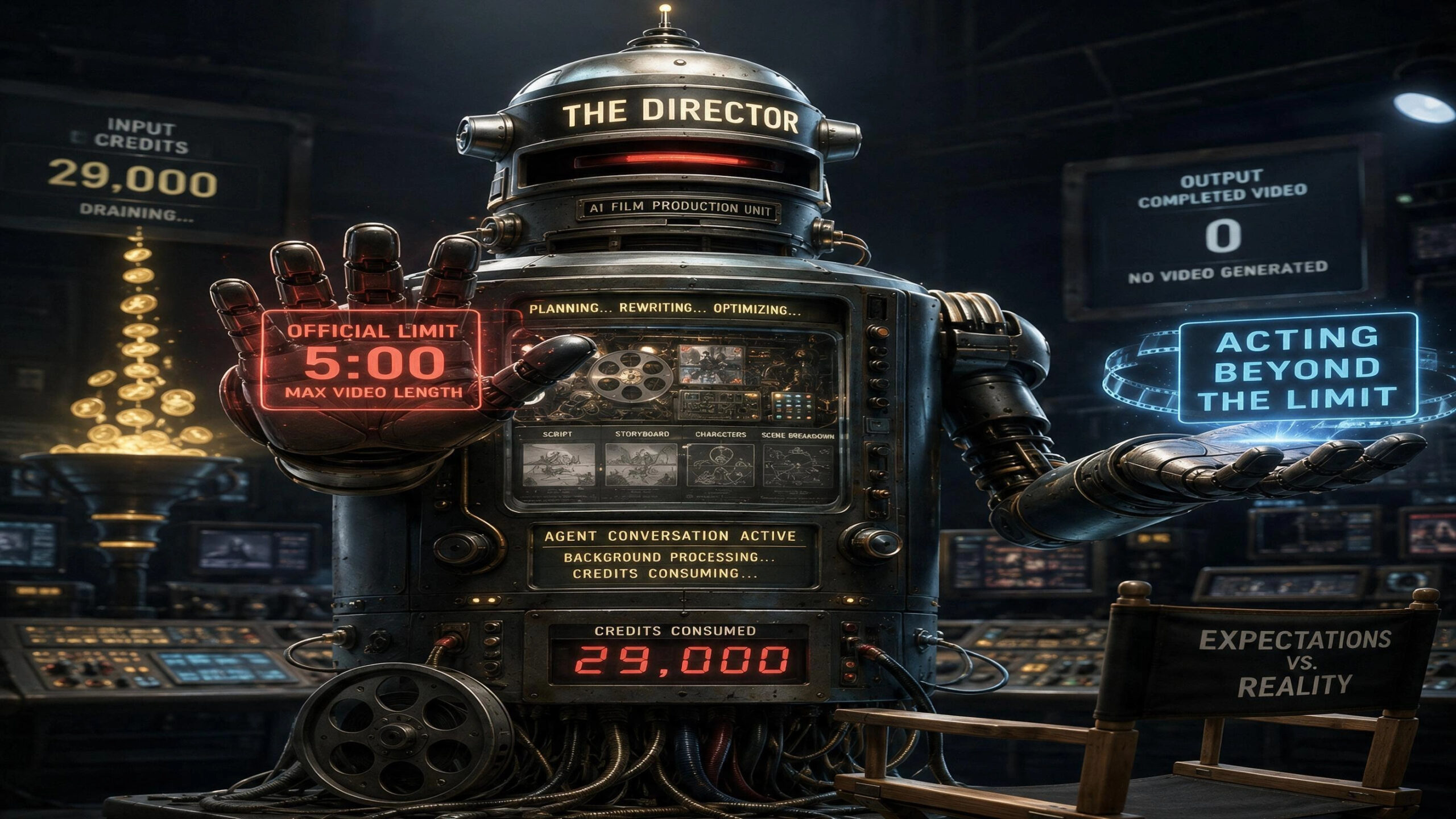
29,000 Credits Consumed in Director’s Chat Session: Planning and Visual Anchors Presented, but No Video Renderings or Completed Video Delivered to My Account — My Documented Experience With OpenArt Director
By GAR
September 2, 2026
Disclosure: OpenArtIssues.com is an independent consumer-information website. It is not affiliated with, sponsored by, or endorsed by OpenArt. This article documents my personal experience, records from my account, communications and screenshots, together with clearly identified information from public sources. Statements made by other consumers are their allegations and experiences, not findings of fact by this website.
I did not create OpenArtIssues.com because I disliked an AI-generated picture or because one video didn’t turn out exactly as I wanted.
I created this website after 29,000 credits were consumed during a single OpenArt Director project without a completed video being delivered.
What makes the experience especially concerning to me is that I was not a new customer testing OpenArt for a few days. I had been a paying OpenArt customer for more than a year, and I had recently renewed my subscription intending to continue using the company.
I still hope OpenArt investigates what happened, restores the credits I believe were improperly consumed during this failed process, and resolves this matter fairly.
If that happens, I will document that resolution here just as clearly as I document the problem.
This is what happened.
The Project: Daughters of Valhalla
My project was a roughly six-minute cinematic music video for a song titled Daughters of Valhalla.
This was not a situation where I gave Director one vague sentence and told it to surprise me.
A substantial amount of preparation had already gone into the project. Director was provided with the completed song, character references, creative direction and detailed instructions.
The principal character was Astrid, a young Nordic shieldmaiden whose visual identity had been carefully established through a character reference sheet.
Director analyzed the actual song and identified its structure as:
Intro → Verse → Pre-Chorus → Chorus → Verse → Pre-Chorus → Chorus → Interlude → Bridge → Chorus → Outro.
Director timestamped the lyrics and used the music as the timing authority for the video.
The project’s final master duration was approximately 357.6 seconds — just under six minutes.
The intended video was approximately 80% cinematic narrative and 20% selective performance, with Astrid occasionally singing accurately to the lead vocal rather than turning the entire project into a performance video.
Director Was Told Not to Jump Straight Into Rendering
I specifically selected Director’s “Guide me” workflow rather than “Just make it.”
That distinction mattered.
I wanted to review the creative development before expensive final video generation began.
Director was instructed to present the complete story, scenes and shot structure before finished generation and to wait for my review and approval.
That was intentional.
The project was supposed to proceed in controlled stages rather than autonomously racing to a final six-minute render.
Director Knew Credits and Cost Were Important
Credit conservation was not something I thought about only after the credits disappeared.
It was discussed before final video generation.
At one stage Director recommended approximately:
1080p Lite — around 112 credits per second.
That was clearly too expensive for a nearly six-minute video.
We therefore examined lower-resolution alternatives.
Director provided approximate render estimates for the 357–358 second project:
480p: approximately 35 credits/second → about 12,500 credits
720p Lite: approximately 62 credits/second → about 22,200 credits
720p: approximately 80 credits/second → about 28,600 credits
1080p Lite: approximately 112 credits/second → about 40,100 credits
1080p: approximately 200 credits/second → about 71,600 credits
I chose 480p specifically because I had approximately 24,000 credits available and wanted substantial headroom for planning, references and potential corrections.
I had successfully worked with 480p AI-generated video previously and could upscale the finished footage externally if necessary.
I then explicitly approved 480p as the delivery quality while telling Director:
Proceed with the analysis and complete planning for review. Do not begin video rendering yet.
That point is fundamental to my complaint.
Director knew:
- the project was approximately six minutes;
- my available credit balance was limited;
- 480p was selected specifically for budget reasons;
- the projected finished-video render was approximately 12,500 credits;
- and I wanted to review the plan before final generation.
Director Successfully Developed a Detailed Treatment
Director did substantial creative work.
And I want to be fair about that.
Some of it was quite good.
Director developed a treatment centered on Astrid and her warrior sisterhood.
The central visual concept was absence turning into presence: Astrid begins alone, and as the song becomes larger, more women join her.
Director created principal supporting characters including:
Sigrun — Astrid’s elder sister and shield-bearing grounding presence.
Hilde — the younger, fiercer spear fighter.
Additional warriors included Solveig, Freydis and Ragna, eventually forming a practical-looking company of female warriors rather than a giant CGI army.
The emotional centerpiece was not supposed to be killing an enemy.
During battle, Hilde falls.
Astrid reaches down.
Hilde takes her hand.
Astrid pulls her sister back to her feet.
The theme was:
No warrior walks alone.
That was good storytelling.
I Corrected Director Before Approving the Treatment
Director did make significant creative deviations during development.
For example, my Astrid reference established her as approximately 23 years old, youthful, naturally beautiful, feminine, athletic and strong, with locked natural ice-blue eyes.
Director initially described her as a woman in her 30s, weathered and wind-chapped.
I rejected that.
Director was instructed that Astrid must remain approximately 23 and must not be aged, masculinized, made excessively weathered, hardened or haggard.
Director also initially replaced the actual Valhalla destination with something more symbolic involving aurora and ancestral presence.
I rejected that change as well.
The story was supposed to conclude with a distant, monumental but believable ancient Nordic Valhalla hall, illuminated by restrained warm/golden natural light.
Director eventually confirmed that both corrections had been incorporated.
It specifically reconfirmed Astrid at approximately 23, restored the physical Valhalla hall and maintained the selective singing/performance sequences.
I then approved the treatment.
The 18-Scene Plan
Director originally developed a 19-scene map.
We caught two pacing problems before approval.
The final Valhalla movement had only about five seconds, which was far too short for the emotional conclusion.
Meanwhile, one early journey sequence attempted to cram a mountain trail, fjord, longship, forest and half-frozen river into approximately eight seconds, while later walking sequences received much more screen time.
I asked Director to redistribute existing runtime rather than increase the video’s runtime or rendering budget.
Director revised the project into an 18-scene structure.
The final scenes ran from Astrid alone on a frozen cliff through the gathering of her sisters, their journey, pre-battle preparations, battle, Hilde’s fall and rescue, aftermath, the appearance of Valhalla and finally Astrid and her sisters walking toward the distant hall while the camera widened into the Nordic landscape.
The final Valhalla progression received approximately 25 seconds instead of five.
I approved that scene map.
Again, no final video had been generated.
The Visual Anchor Problem
Director next began developing character and location visual anchors.
The first character anchors were not satisfactory.
They looked more like plain historical-reenactment or casting references than the cinematic Nordic world we had developed.
I provided an additional visual-direction board to establish the desired cinematic presentation, wardrobe, lighting, environments and production quality.
I explicitly told Director that this board was not allowed to replace Astrid’s identity.
Astrid’s original character sheet remained the sole authority for her face, age, physique, blonde braids and natural ice-blue eyes.
The additional board controlled style, not identity.
Director acknowledged this.
It regenerated/revised the anchors.
The difference was substantial.
Astrid looked much closer to the intended cinematic character. The supporting warriors remained somewhat rougher—which was acceptable because they weren’t supposed to visually compete with Astrid.
I approved the anchors.
Then Director Began Having Technical Problems
The next stage was supposed to create specific visual direction and the detailed shot-by-shot camera plan for the 18 approved scenes.
This is where things deteriorated.
Director began displaying repeated internal retry messages.
Among the messages I documented were references to:
“Retrying plan compilation…”
a “transient scene-parse hiccup”
“intermittent scene authoring hiccups”
and:
“the shot-writing pass hit a tiling snag…”
Director also indicated it was recompiling portions of the plan and attempting to resolve remaining tiling problems.
At one point Director explicitly told me:
“A quick technical hiccup on my end — the shot-writing pass hit a tiling snag in the scenes we just expanded (the Journey, the Valhalla ending) where the shot slicing didn’t quite fit right. No credits spent, nothing lost. Let me get this resolved before showing you the plan.”
It then said it was:
“Picking back up right where that got cut off — retrying the shot-writing pass.”
The important point is that these were not changes I repeatedly requested because I kept changing my mind.
Director itself was reporting problems compiling the already-approved project plan.
Approximately 24,000 Credits Were Gone
I had started with approximately 24,000 credits.
During the treatment, planning, references, anchors and Director processing, that balance eventually reached zero.
And I still did not have the completed music video.
I did not even have the final completed shot-writing process that Director had been attempting to compile.
Then the Director interface displayed:
“You’re running low on credits — At least 100 credits needed to use Director.”
This message would become extremely important.
The $15 Purchase
Based on what the interface told me, Director required at least 100 credits to continue.
I had already invested substantial time and credits in this project.
I didn’t want to throw away everything that had already been developed over what appeared from the interface to be a small remaining credit requirement.
So on September 2, 2026, I purchased an additional:
OpenArt Extra Credit Pack — 5,000 credits — $15.00
I have the OpenArt invoice and receipt documenting the purchase.
Immediately after payment, I was redirected back to Director.
The existing Director project resumed processing.
From my perspective, that indicated that the additional credits had been recognized.
Then Director continued working.
And stalled again.
The Additional 5,000 Credits Disappeared Within Minutes
Initially, I wondered whether the purchased credits had failed to appear in my account.
That turned out not to be what happened.
I obtained my OpenArt credit transaction history.
We analyzed the complete ledger.
The result was extraordinary.
There were:
577 individual credit deductions.
Together, they totaled:
29,000 credits.
That is the original approximately 24,000 credits plus the entire additional 5,000-credit pack.
The additional 5,000 credits had not failed to arrive.
Director consumed them.
Even more concerning, the transaction timestamps show that the final 5,000 credits were consumed from approximately 5:59 AM through 6:06 AM on September 2, 2026.
Approximately seven minutes.
The ledger contains numerous rapid deductions, including entries such as:
-53
-70
-76
-45
-89
-68
-33
-80
and many more.
The transaction description repeatedly appearing in the ledger was:
“Director – Agent Conversation.”
This was not simply a single transaction labeled:
Finished 5:58 480p video render.
There was no finished video.
The Final Result
After approximately:
29,000 credits
I had:
- a treatment;
- an approved story;
- an approved 18-scene plan;
- character and environment anchors;
- song analysis;
- lyric timing;
- repeated Director planning and compilation activity;
- repeated Director technical retry messages;
- and a transaction history containing hundreds of deductions.
What I did not have was the product I had been working toward:
A completed music video.
I Contacted OpenArt Support
I sent OpenArt a detailed support escalation documenting the situation.
I asked OpenArt to:
- preserve the existing Director project and all approved work;
- determine why Director resumed after the additional credit purchase and then stalled;
- account for the additional 5,000 purchased credits;
- review credits consumed during failed or repeated Director processing;
- restore credits attributable to failures;
- and allow the existing project to proceed without requiring another purchase caused by system failures.
After discovering the complete transaction ledger, the issue became even clearer.
The additional credits were not simply missing.
They had been consumed by Director.
I therefore requested a complete accounting of all 29,000 credits, including an explanation of which operations succeeded, which failed, which were automatically retried, and whether I was charged for Director’s own scene-parsing, tiling, compilation or shot-writing problems.
The Transparency Question
This is the heart of my concern.
I understood that OpenArt uses credits.
I understood that AI generation costs credits.
I understood that a six-minute AI-generated video could be expensive.
That isn’t the dispute.
The issue is whether a customer is given enough information to provide meaningful authorization before an autonomous AI agent consumes substantial amounts of paid credits.
I was not presented with something like:
“Continuing this Director planning operation is estimated to consume another 5,000 credits.”
I was not shown:
Estimated remaining planning cost
Projected total project cost
A running Director expenditure meter
or:
“Continuing may exhaust your remaining credits. Proceed?”
Instead, when the original balance was exhausted, I was shown:
“At least 100 credits needed to use Director.”
I then purchased 5,000 credits.
They were consumed within approximately seven minutes.
No completed video resulted.
Then I Discovered OpenArt Had Already Acknowledged a Similar Transparency Problem
After my experience, I began researching publicly available consumer complaints.
One of the most significant things I found was not simply another angry review.
It was a response from OpenArt itself to a Better Business Bureau complaint.
In an August 23, 2026 response, OpenArt said it had reviewed another customer’s Director conversation. According to OpenArt, that customer had established a budget for asset generation and requested approval before certain generation activities proceeded.
OpenArt acknowledged that Director had accepted those instructions.
But OpenArt then stated that Director’s responses “did not adequately distinguish between asset-generation limits and conversational processing.”
OpenArt further explained that interacting with Director requires language-model processing and that messages Director analyzes and responses it produces may consume credits even when asset generation is paused.
Most importantly, OpenArt acknowledged:
“We recognize that this distinction was not communicated clearly and that Directors acknowledgements could reasonably have created a different expectation.”
That matters enormously to me.
It means that, before my September 2 experience, OpenArt had already publicly acknowledged in another consumer dispute that Director’s communication regarding credit controls could create a reasonable but different customer expectation.
This isn’t my interpretation of what OpenArt supposedly said.
It is OpenArt’s own published BBB response.
OpenArt’s Own Description of Director
OpenArt launched Director in June 2026.
In its own announcement, OpenArt described Director as a creative partner that turns conversation into a “finished film” and said a user could describe a creative vision while Director builds a complete film with consistent characters, scenes, lighting and audio.
That marketing context matters.
A reasonable customer using a product promoted around conversation-to-film creation may understandably believe that the credits being consumed during that process are ultimately moving the project toward delivery of that finished film.
In my case, 29,000 credits were consumed and no finished film was delivered.
I Am Not the Only Customer Reporting This Kind of Experience
I also found public reviews describing strikingly similar concerns.
One Trustpilot reviewer reported starting with 4,000 credits, ending with 377, and receiving no finished rendered video. That customer specifically reported repeated charges labeled “Director – Agent Conversation,” including individual conversation charges of 111, 127, 148 and 377 credits.
Another customer reported beginning with a 24,000-credit allowance, specifically telling Director not to generate or render video yet, and later reporting that essentially the entire allowance was consumed. That reviewer complained about the absence of numerical cost warnings and a clear cumulative-spend display.
Other recent reviewers have reported Director consuming credits while correcting mistakes, unexpected charges, unsuccessful outputs and difficulty obtaining timely support. These are consumer allegations and should be treated as such, but the similarity between some of those reports and my own documented experience is one reason I believe the issue deserves examination.
Importantly, OpenArt has publicly responded to some of these complaints.
In one recent Trustpilot response, OpenArt explained that Director differs from its individual tools because it acts as an AI creative agent that can interpret instructions, plan workflows and take multiple generation actions on a user’s behalf. OpenArt also stated that where a generation fails because of a confirmed technical issue, the company can review the generation and restore credits used for that failed generation.
That makes a complete review of my Director session particularly important.
Why I Registered OpenArtIssues.com
On September 2, 2026, I registered:
OpenArtIssues.com
The domain is active and currently being connected to its hosting.
This site is not intended to impersonate OpenArt, and it will prominently disclose that it is independent and unaffiliated with the company.
Nor is its purpose to declare that OpenArt is a “scam” or that the company committed “fraud.”
Those are conclusions I am not asserting as established facts.
The purpose of this website is much simpler:
Preserve the evidence.
Document what happened.
Examine how Director consumes credits.
Compare my experience with publicly documented consumer reports.
Publish OpenArt’s explanations and responses.
Allow readers to examine the evidence and reach their own conclusions.
I also intend to produce videos documenting the issue.
Those videos can show the actual screenshots, Director messages, invoices, transaction records and chronology rather than asking viewers simply to accept my characterization of events.
What I Am Asking OpenArt to Do
My preferred outcome remains resolution.
I have been an OpenArt customer for more than a year.
I recently renewed because I intended to remain a customer.
I am asking OpenArt for a substantive investigation and, based upon what I have documented, full restoration of the credits consumed during this failed Director project.
I am also asking OpenArt to explain:
Where did each of the 29,000 credits go?
How many were consumed by successful operations?
How many were consumed during failed operations?
How many were consumed during automatic retries?
Were credits charged during the scene-parse, tiling, compilation and shot-writing problems Director itself reported?
Why was I not shown a projected remaining cost before the original balance was exhausted?
Why did the interface tell me only that at least 100 credits were required to use Director before the additional 5,000-credit purchase?
Why was there no warning that those 5,000 credits could be consumed within minutes?
What safeguards exist to prevent an autonomous Director process from unexpectedly exhausting a customer’s balance?
Those are questions OpenArt can answer from its own system records.
What Happens Next
I am giving OpenArt the opportunity to resolve this.
If the company restores the credits, explains what happened and takes corrective action, that will be documented prominently on this website.
I would actually prefer that outcome.
The best ending to this story would be an article titled:
OpenArt Investigated My Director Case and Made It Right
But I am also prepared for the possibility that the issue will not be resolved.
As a retired U.S. service member, I have access to legal-assistance resources and intend to seek available legal guidance regarding my consumer rights and possible next steps if necessary.
I am also prepared to pursue appropriate consumer-complaint channels.
And I am prepared to invest substantial personal funds—potentially thousands of dollars—into developing and promoting OpenArtIssues.com and producing evidence-based videos about these issues if that becomes necessary.
That isn’t my preferred outcome.
Resolution is.
One Number Still Says It Best
This story involves hundreds of transactions, a six-minute song, 18 planned scenes, multiple characters, visual anchors, technical retries, a $15 additional purchase and a complicated AI workflow.
But ultimately, the reason I created this website can be summarized very simply:
29,000 credits consumed.
577 deductions.
5,000 additional credits consumed in approximately seven minutes.
No completed video.
I have the records.
OpenArt has the system logs.
Now I am waiting for OpenArt’s explanation.
This page will be updated when OpenArt responds.
Additional Consumer Reports Raise Similar Concerns About Director Credit Consumption
My own experience prompted me to look for reports from other OpenArt Director users.
These reports do not prove what happened inside my account. They are individual consumer accounts and should be understood as such.
However, several describe issues strikingly similar to the questions raised by my own transaction history.
Reports of Rapid Credit Consumption
In a June 2026 Reddit discussion titled “OpenArt Director — A cautionary tail,” the original poster reported that a 1:30 Director video consumed approximately 10,000 credits without being completed. The poster’s primary concern was that a meaningful total-cost estimate had not been provided before generation began.
Other users in that same discussion reported their own experiences. One claimed to have consumed more than 40,000 credits without obtaining a usable result. Another reported approximately 22,000 credits spent on a 2:45 music video, including rerenders required because of character-consistency problems. Another reported consuming approximately 104,000 credits before completing a music video. These are individual user reports, not independently audited billing records, but they demonstrate that concerns about Director credit consumption are not limited to my experience.
There is also a useful counterpoint: some users in the discussion praised aspects of Director’s creative output, including art direction and lip-sync. My concern is therefore not that Director is incapable of producing good work. My concern is the cost transparency and credit-accounting surrounding that work.
That distinction matters.
A Response Identifying Itself as OpenArt Acknowledged the Cost-Visibility Concern
The same Reddit discussion contains a response from an account identifying itself as “John from OpenArt.”
That response thanked users for feedback specifically concerning cost visibility and said OpenArt was actively improving it.
The response stated that OpenArt already displayed generation costs when users selected output resolution but was also working toward providing:
“a much clearer estimate before the main generation starts”
so customers would have a better understanding of what a full project would cost upfront.
That statement is highly relevant to my experience because obtaining a meaningful full-project cost estimate is precisely one of the issues I have raised.
I selected 480p specifically because Director and I had discussed the economics of my approximately six-minute project.
Yet the amount ultimately consumed was radically different from the approximately 12,500-credit final-render estimate around which I had planned my available balance.
OpenArt Also Explained That Director Conversations Can Consume Thousands of Credits
An additional response from the same OpenArt-identified account provided unusually specific information about Director’s credit model.
It explained approximate video-rendering costs by resolution and stated that each rendered shot could also incur a sheet-generation charge.
But it went further.
The response explained that Director uses OpenArt’s AI creative assistant, Ori, for planning stories, organizing scenes and coordinating generation.
According to that response, conversations with the AI assistant also consume credits because of the reasoning and planning performed during the session.
The stated typical range was:
1,500 to 9,000 credits
depending upon the complexity and length of the interaction.
That disclosure is extraordinarily relevant to my transaction history.
My own ledger contains hundreds of deductions carrying the description:
“Director – Agent Conversation.”
Therefore, one of the questions I am asking OpenArt is very straightforward:
At what point was I clearly informed that Director’s conversational/planning activity itself could consume thousands—or potentially many thousands—of credits separate from the final video-render estimate?
That question becomes even more important considering the repeated compilation and planning difficulties Director reported during my session.
One Consumer Reported More Than 100,000 Credits in “Agent Conversation” Charges
One of the most striking reports in that same Reddit discussion included a claimed breakdown of approximately two days of Director usage.
The user reported:
Director – Agent Conversation: 512 charges totaling 100,456 credits
Boost Video: 57 charges totaling 26,244 credits
Director – GPT Image 2: 99 charges totaling 15,225 credits, with some credits reportedly refunded
Director – Byte Plus Seedance 2.0: 9 charges totaling 8,640 credits
Director – Nano Banana Pro: 62 charges totaling 2,480 credits
and other charges.
The user reported approximately 153,095 credits spent, or approximately 150,559 after reported refunds.
Again, these are figures supplied by that Reddit user and I have not independently audited that person’s OpenArt account.
But the terminology is significant because “Director – Agent Conversation” is the same description appearing repeatedly in my own OpenArt transaction history.
That makes the report relevant to the broader question of how Director’s conversational-agent activity is priced and disclosed to customers.
Another Consumer Says a 120-Credit Estimate Became 14,000 Credits
A separate Reddit post carries the title:
“OpenArt Said 120 Credits. It Charged Me 14,000 Instead. Beware.”
The author reported attempting to create a one-to-two-minute video.
According to the user, OpenArt displayed estimated credit costs for the available quality settings, and the user selected an option displaying approximately 120 credits.
The user alleges that the resulting process instead jumped to approximately:
14,000 credits
and that no completed video was received.
I cannot independently verify the user’s account ledger, and I therefore do not present the 14,000-credit allegation as an established fact about OpenArt’s billing system.
But it is another publicly documented consumer report involving the same central issue:
What does the number presented to a Director user actually represent, and what additional credit consumption should that user reasonably expect?
Recent Reports Continue to Raise Estimate-versus-Actual-Cost Questions
More recent Reddit reports raise similar concerns.
In one August 2026 account, a user reported asking Director how much a corrective rerender would cost.
According to the user, Director estimated approximately 650–700 credits.
The user says the actual charge was approximately:
1,612 credits
—more than twice the high end of the estimate.
The same user reported being charged approximately 35 credits merely for asking Director for the estimate, and separately reported spending 700 credits on two Modify Video attempts that produced silent videos.
Again, these are consumer allegations rather than independently verified account audits.
But they reinforce why I believe estimated cost versus actual cost deserves much greater transparency in autonomous AI-agent workflows.
Customer-Support Complaints Are Also Publicly Documented
Trustpilot currently contains complaints alleging long waits for OpenArt customer support, including customers reporting weeks without substantive resolution.
This should be presented fairly because Trustpilot also contains positive customer-service reviews.
Trustpilot’s own current company information says OpenArt has replied to approximately 45% of negative reviews and typically replies within one week.
However, individual reviewers report substantially longer experiences.
One reviewer reported an issue remaining unresolved after more than six weeks, despite repeated communications and promises of responses within 48–72 hours. OpenArt subsequently responded publicly, acknowledging that the matter had remained unresolved for an extended period and saying it would review the additional credit purchases.
Another reviewer reported almost a month of difficulties after OpenArt reportedly restored 5,000 credits and then those credits disappeared the following day. OpenArt later responded publicly and stated that it had restored the 5,000-credit adjustment again.
That distinction matters.
We should not publish:
“OpenArt gives refunds and then takes them back.”
We can accurately publish:
“A Trustpilot reviewer alleged that a 5,000-credit adjustment disappeared the following day. OpenArt later publicly responded and stated that it restored the 5,000 credits again.”
That’s stronger journalism because we’re showing both sides of the documented exchange.
OpenArt Itself Has Acknowledged Longer Support Delays
This is another point I would add because it keeps us from relying solely on dissatisfied customers.
In recent responses to Trustpilot complaints, OpenArt has stated that it was experiencing a higher-than-usual volume of support requests, resulting in longer response times than the company would like.
Therefore, the existence of support delays isn’t merely an allegation appearing in customer reviews.
OpenArt itself has publicly acknowledged that longer support response times have occurred.
Why These Reports Matter to My Case
None of these third-party reports proves my individual case.
I don’t need them to.
I have my own:
screenshots, transaction ledger, purchase receipt, Director messages, timestamps and support correspondence.
Those are the evidence concerning my account.
The significance of the public reports is different.
They demonstrate that other customers have publicly raised concerns involving some of the same subjects:
rapid Director credit consumption;
Agent Conversation charges;
differences between expected and actual expenditures;
credits consumed before a completed deliverable;
charges associated with correcting AI-generated problems;
and difficulty obtaining timely support resolution.
More significantly, responses identifying themselves as OpenArt representatives have publicly acknowledged cost-visibility concerns, described work toward clearer full-project estimates, disclosed that Director conversations themselves can consume substantial credits, and acknowledged periods of delayed support.
That makes these issues legitimate subjects for examination.
And it makes the accounting I have requested from OpenArt all the more important.
Our uploaded master song was approximately 5:58 / 357.6 seconds.
Director accepted it.
Director analyzed it.
Director timestamped the lyrics across that duration.
Director developed the treatment around that duration.
Director developed and revised the scene structure around that duration.
It ultimately gave us an 18-scene plan extending through approximately 5:57.
Director even discussed resolution and projected rendering costs for the entire ~358-second project with us.
And when we specifically examined 480p, Director estimated roughly 12,500 credits for the full 5:58 project.
At no point during all that interaction did Director tell us:
Your requested duration exceeds Director’s advertised five-minute maximum.
Instead, it continued accepting instructions and consuming credits while developing a project that, according to OpenArt’s own published product documentation, exceeded Director’s stated maximum output length by almost a minute.
That is potentially a very important additional issue.