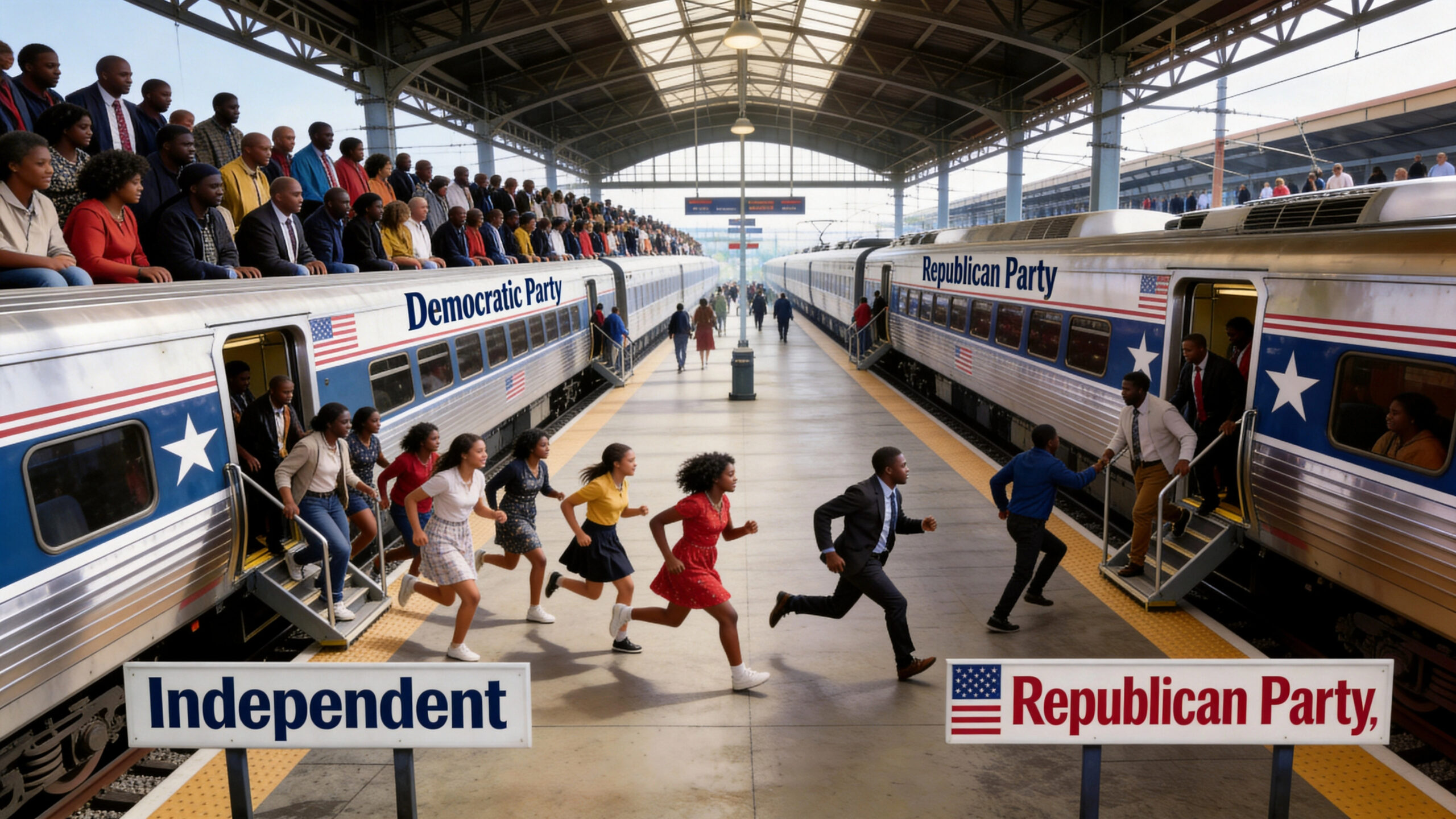
Why do so many Blacks in America support the Democratic Party who was behind Jim Crow, KKK, and Slavery?
Black Voters and the Democratic Party: Loyalty, Leverage—and a Quiet Shift
For nearly a century, one political fact has held steady:
Black Americans overwhelmingly vote Democrat.
In recent presidential elections, roughly 85–92% of Black voters supported Democratic candidates (Pew Research Center; U.S. Census voting data).
But here’s the real story most headlines miss:
That loyalty was built over time—and it may not be as permanent as it looks.
The Untold Reality: This Wasn’t Always the Case
Let’s start with a fact that often gets overlooked:
Black Americans were once overwhelmingly Republican.
After the Civil War, the Republican Party—founded on anti-slavery principles and led by Abraham Lincoln—dominated Black political support for decades.
That didn’t begin to change until the 1930s.
The First Break: The New Deal
During the Great Depression, Franklin D. Roosevelt introduced the New Deal—massive federal programs aimed at economic recovery.
According to historians and data compiled by sources like the National Archives and Princeton University Press, Black voters began shifting toward Democrats as early as 1936, largely due to:
- Federal job programs
- Economic relief initiatives
- Expanded government assistance
Even though these programs were often unevenly applied—especially in the segregated South—they still represented something new:
Direct federal support.
And when people are struggling, results matter more than party history.
The Turning Point: Civil Rights and Federal Power
The realignment became permanent in the 1960s.
Democratic leadership passed:
- Civil Rights Act of 1964
- Voting Rights Act of 1965
These laws ended legal segregation and expanded voting protections.
According to the Library of Congress and U.S. Department of Justice historical records, these policies dramatically increased Black voter registration and participation—especially in the South.
But there’s another side to this story.
These laws also marked a major expansion of federal authority.
At the same time, Republicans increasingly positioned themselves as the party of:
- Limited government
- States’ rights
- Individual liberty
From a conservative perspective, this wasn’t just a moral shift—it was a philosophical one.
Why the Loyalty Stayed So Strong
Fast forward to today, and the numbers are still striking.
According to Pew Research Center (2020, 2024 analyses):
- Around 9 in 10 Black voters identify with or lean toward the Democratic Party
- Black voters remain the most politically unified demographic group in the U.S.
Why?
1. Perception Is Powerful
For decades, Democrats have successfully positioned themselves as the primary advocates for minority communities.
2. Voting as a Bloc = Political Power
Political scientists often describe this as strategic unity—voting together increases influence in a two-party system.
3. Republican Messaging Gap
Despite promoting policies like school choice and entrepreneurship, Republicans have historically struggled to consistently engage Black communities.
But Here’s What’s Changing (And Why It Matters)
Now comes the part that’s getting harder to ignore:
There are early signs of a shift.
Not massive. Not overnight.
But real—and growing.
1. Economic Frustration Is Boiling Over
Despite decades of loyalty, many Black Americans still face:
- Lower median household wealth (Federal Reserve data)
- Slower income growth
- Rising housing costs
According to the Federal Reserve’s Survey of Consumer Finances, the Black–white wealth gap remains significant.
That’s leading more voters to ask:
“If we’ve been voting the same way for 50+ years… what’s changed?”
2. School Choice Is Breaking Through
Education is becoming a wedge issue.
Research from organizations like the American Federation for Children and polling cited by EdChoice shows growing Black support for:
- Charter schools
- School vouchers
- Alternatives to failing public schools
In many cities, this issue cuts across party lines—and often aligns more closely with conservative policy proposals.
3. Crime and Public Safety Are Reshaping Priorities
Concerns about crime have risen in several major urban areas.
Polling from Gallup and local surveys shows that:
- Black Americans often prioritize safe neighborhoods as a top issue
- Support for increased policing can be higher than media narratives suggest
This creates tension with policies perceived as reducing law enforcement presence.
4. Cultural Values Don’t Always Match the Platform
According to Pew Research Center religious landscape studies:
- Black Americans are among the most religious demographic groups in the U.S.
- Many hold moderate or conservative views on certain social issues
That doesn’t always align neatly with the modern Democratic platform.
5. A New Generation Isn’t Following Old Rules
Younger voters are different.
With the rise of independent media, podcasts, and social platforms:
- Political narratives are being challenged
- Alternative viewpoints are more accessible
- Party loyalty is no longer automatic
Data from Gallup shows a steady rise in Americans—across demographics—identifying as independent rather than strictly partisan.
Black voters are part of that trend.
The Numbers Don’t Lie—But They Are Moving
Yes, Democrats still dominate the Black vote.
But:
- Republican support among Black men has shown modest increases in recent elections (CNN exit polls, Pew analysis)
- Democratic margins, while still large, have slightly narrowed in some cycles
- Independent identification is growing
These are small shifts.
But in politics?
Small shifts turn into big changes—fast.
The Real Question No One Wants to Ask
Here’s the uncomfortable reality:
When one party receives 85–90% of the vote from a group, accountability can fade.
That’s not a partisan statement—it’s basic political math.
Which leads to a bigger question:
Is this loyalty being earned—or assumed?
Final Thought: No Vote Is Guaranteed Forever
History shows us something important:
Voting patterns change.
They changed in the 1930s.
They changed in the 1960s.
And they can change again.
Right now, we’re not seeing a political earthquake.
But we are seeing cracks:
- More questions
- More independence
- More willingness to think differently
And in politics, that’s where every major shift begins.
Sources & Data References
- Pew Research Center (Voting Trends, Party Identification, Religion Studies)
- U.S. Census Bureau (Voting and Registration Data)
- Federal Reserve (Survey of Consumer Finances)
- National Archives (New Deal and historical voting shifts)
- Library of Congress (Civil Rights legislation history)
- U.S. Department of Justice (Voting Rights Act enforcement data)
- Gallup (Party identification, crime perception polling)
- EdChoice & American Federation for Children (School choice polling)
- CNN Exit Polls (Recent election demographic trends)
- Princeton University Press (Historical political realignment research)